


 Back to News & Events
Introduction: Powering the NewSpace Revolution
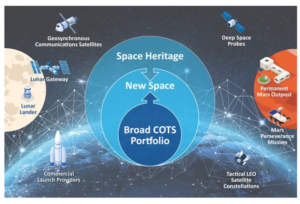
The rapid expansion of the commercial space industry is transforming satellite development. The emergence of NewSpace, driven by smaller satellites, CubeSats, and large Low Earth Orbit (LEO) constellations, is creating new opportunities in satellite communications, Earth observation, navigation, scientific research, and commercial space applications.
Unlike traditional space programs, which often rely on highly customized and costly systems, NewSpace missions increasingly demand compact, lightweight, cost-effective, and scalable power solutions without compromising reliability.
At the heart of every satellite is its electrical power system. Selecting the right DC/DC converters, power management devices, and semiconductor components is essential to ensure stable operation, protect sensitive electronics, and maintain performance throughout the mission lifecycle.
Horizon Electronics supports satellite manufacturers and NewSpace developers by providing access to advanced space-grade power conversion products and high-reliability semiconductor components from leading manufacturers, including VPT, together with technical guidance throughout the component selection process.
- Understanding the Electrical Challenges of Space Missions
One of the first considerations when selecting power supply components is the satellite’s orbital environment.
Low Earth Orbit (LEO) satellites typically operate at altitudes between approximately 160 and 2,000 km. Their relatively short orbital periods and increasing deployment in large constellations make them particularly important to the NewSpace industry.
Geostationary Orbit (GEO) satellites operate at approximately 35,786 km above Earth. They remain above a fixed geographical position and are commonly used for telecommunications, broadcasting, and weather monitoring.
Each orbital environment presents different radiation and electrical challenges.
Spacecraft electronics are exposed to several radiation-related effects:
- Total Ionizing Dose (TID): The cumulative radiation absorbed by electronic components throughout the mission.
- Single Event Effects (SEE): Electrical disturbances or permanent damage caused by individual energetic particles striking semiconductor devices.
- Displacement Damage (DD): Damage to semiconductor crystal structures caused by energetic particles.
Radiation exposure depends on orbital altitude, inclination, mission duration, shielding, and solar activity. Consequently, component selection must be based on the actual radiation environment and mission-specific Radiation Hardness Assurance (RHA) requirements.
For many LEO and NewSpace applications, radiation-tolerant components can provide an appropriate balance between performance, cost, and reliability. More demanding missions may require radiation-hardened solutions with higher qualification levels.
Understanding these requirements early in the design process helps engineers select appropriate components and reduce the risk of failures during operation.
- DC/DC Power Conversion: Flexibility and Performance
Satellite power architectures must accommodate different input voltage levels and multiple secondary voltage rails.
Solar arrays and battery systems provide the primary electrical energy, which must be converted into stable, regulated voltages for onboard subsystems.
Common spacecraft bus voltages include 28V, 50V, 72V, 100V, and 120V. DC/DC converters transform these input levels into secondary voltages such as 3.3V, 5V, 12V, 15V, and 28V.
These voltage rails supply sensitive electronic loads, including:
- Microcontrollers (MCUs) and FPGAs.
- Communication and RF subsystems.
- Navigation and control electronics.
- Sensors and scientific payloads.
Depending on the system architecture, additional point-of-load regulation using Low Dropout Regulators (LDOs) may be required.
Engineers should evaluate DC/DC converters based on input voltage range, output configuration, regulation accuracy, efficiency, isolation, thermal performance, and compatibility with the overall power architecture.
Selecting configurable and scalable power components can simplify system integration, reduce redesign requirements, and shorten development cycles.
- SWaP-C: Size, Weight, Power and Cost Optimization
Size, Weight, Power, and Cost (SWaP-C) are among the most important design considerations in modern satellite development.
Every additional gram and every cubic centimeter can affect launch costs, available payload capacity, and overall mission economics.
Power supply components must therefore deliver the required electrical performance within strict mechanical and thermal constraints.
Key considerations include:
Power Density: Higher power density allows engineers to deliver more electrical power within a smaller footprint.
Efficiency: High conversion efficiency minimizes power losses and heat generation, helping simplify thermal management and maximize available energy.
Weight and Dimensions: Compact, lightweight converters help maximize available space and payload capacity.
Thermal Performance: Components must maintain stable operation across demanding temperature ranges and repeated thermal cycles.
Cost Optimization: NewSpace programs often require scalable solutions suitable for multiple satellite units and constellation deployments.
Achieving the right balance requires careful component selection. A smaller or less expensive converter is not necessarily the best solution if it introduces additional thermal, radiation, or reliability risks.
- Radiation Tolerance and Environmental Reliability
Space power supplies and semiconductor components must operate in an environment characterized by vacuum, extreme temperature variations, radiation exposure, and mechanical stress during launch.
Unlike terrestrial electronics, spacecraft components cannot be easily replaced or serviced once a satellite is in orbit.
Engineers must therefore evaluate not only electrical specifications but also the qualification and reliability data supporting each component.
Important considerations include:
- Radiation testing and qualification, including TID and SEE performance.
- Thermal operating range and temperature derating.
- Low-outgassing materials suitable for vacuum environments.
- Electromagnetic interference (EMI) and electromagnetic compatibility (EMC).
- Vibration and mechanical qualification.
- Component screening, traceability, and manufacturing consistency.
The distinction between radiation-tested, radiation-tolerant, and radiation-hardened components is particularly important. These terms represent different levels of testing and assurance and should not be considered interchangeable.
The appropriate qualification level depends on the satellite’s orbit, expected mission duration, acceptable risk, and overall system requirements.
- Space-Qualified DC/DC Converters from VPT
DC/DC converters are fundamental building blocks of satellite power architectures. They provide regulated and isolated power to critical subsystems while helping maintain electrical stability under changing operating conditions.
Horizon Electronics is the exclusive representative of VPT in Israel, providing customers with access to specialized power conversion products for aerospace, satellite, and NewSpace applications.
One example is the VPT VSC5-2800S, a 5W space-qualified DC/DC converter designed for the NewSpace market.
Designed for smaller LEO satellites and NASA Class D missions, the VSC5-2800S addresses applications where cost, size, and guaranteed performance must be carefully balanced.
Key technical characteristics include:
- 5W power rating.
- Wide input voltage range of 15–50 VDC, with 80V transient capability.
- Radiation Lot Acceptance Tested (RLAT) components.
- SEE tested to 42 MeV·cm²/mg, with a guaranteed level of 30 MeV·cm²/mg.
- TID tested to 40 krad(Si), with a guaranteed level of 30 krad(Si).
- Operating temperature range of -55°C to +100°C.
- Low-outgassing packaging materials.
- Dual-side heatsinking capability.
These characteristics make the VSC5-2800S an option for satellite platforms requiring compact power conversion and defined radiation performance.
Explore the VPT VSC5-2800S Space-Qualified DC/DC Converter.
- High-Reliability Semiconductor Components for Space Applications
Reliable satellite operation depends not only on DC/DC converters but also on the individual semiconductor components used throughout power management, regulation, protection, and control circuits.
Through its partnership with VPT Components, Horizon Electronics provides access to a broad portfolio of high-reliability semiconductor components for aerospace, satellite, and defense applications.
High-Reliability Transistors
Transistors are essential building blocks in satellite electronics, supporting switching, amplification, power regulation, and control functions.
The VPT Components portfolio includes:
- NPN and PNP small-signal bipolar transistors.
- Medium- and high-power switching transistors.
- Radiation-hardened qualified NPN and PNP transistors.
- MOSFETs for power switching applications.
- Silicon Controlled Rectifiers (SCRs).
- JANHC and JANKC qualified semiconductor die.
Bipolar transistor products are qualified to applicable MIL-PRF-19500 slash sheets and are available in different military quality levels, including JAN, JANTX, JANTXV, JANS, and JANSR, where applicable.
These components support satellite power management, switching circuits, and other mission-critical electronic subsystems.
Explore the VPT High-Reliability Transistor Portfolio.
High-Reliability Diodes
Diodes provide essential functions in voltage regulation, circuit protection, signal switching, and power conversion.
Horizon Electronics supplies a selection of VPT Components diodes qualified to MIL-PRF-19500, including:
- Zener Voltage Regulator Diodes: For voltage regulation and reference circuits.
- Low-Voltage Avalanche Zener Diodes: For transient and surge protection.
- Silicon Switching Diodes: For high-frequency, RF, and communication circuits.
- Silicon Rectifier Diodes: For power conversion and conditioning.
- Silicon Controlled Rectifiers (SCRs): For controlled power switching.
Available package options include axial glass, MELF, ceramic, and chip configurations, with qualification levels depending on the device.
Explore the VPT High-Reliability Diodes Portfolio.
By combining space-qualified DC/DC converters with high-reliability discrete semiconductor components, Horizon provides customers with access to a broader range of technologies required for modern satellite power and electronic architectures.
- Why Choose Horizon Electronics for NewSpace Power Solutions?
Selecting power supply components for a satellite is more than a matter of matching input and output voltages. Engineers must consider the complete mission profile, environmental conditions, electrical architecture, qualification requirements, and long-term component availability.
Horizon Electronics works with customers to identify suitable power solutions from leading manufacturers and supports the component selection process according to individual project requirements.
Our capabilities include:
- Technical Guidance: Assistance in selecting DC/DC converters and semiconductor components according to electrical, environmental, and radiation requirements.
- Application-Oriented Solutions: Components for CubeSats, LEO satellite constellations, communication systems, and other commercial and aerospace applications.
- Project Support: Assistance throughout the component selection process, helping customers identify suitable technologies for their specific requirements.
For a broader overview of available technologies and solutions, visit our Space-Grade Power Supplies and Solutions page.
Conclusion: Reliable Power for the Next Generation of Space Missions
As the NewSpace industry continues to evolve, satellite manufacturers face increasing pressure to develop smaller, more efficient, and more cost-effective platforms while maintaining stringent reliability requirements.
The selection of appropriate DC/DC converters and semiconductor components plays a critical role in achieving these objectives.
With access to advanced space-qualified power components and high-reliability semiconductor technologies from leading manufacturers, together with technical support throughout the selection process, Horizon Electronics helps NewSpace developers identify power solutions that meet the demands of today’s satellite technologies and tomorrow’s space missions.
Looking for the right power components for your next space project? Contact Horizon Electronics to discuss your application and technical requirements.


