Back to News & Events
 Designing power systems for medical equipment requires far more than selecting the right voltage and wattage. In medical applications, the power supply is a critical part of the device’s overall safety, reliability, and regulatory compliance.
For engineers developing medical equipment, IEC 60601-1 is one of the key standards to understand. It establishes requirements for the basic safety and essential performance of medical electrical equipment, with important implications for power supply architecture, isolation, leakage current, grounding, and protection against electric shock.
Selecting the right power supply early in the design process can help reduce redesign risk and support reliable operation throughout the product lifecycle.
What Is IEC 60601-1?
IEC 60601-1 is the international standard for the basic safety and essential performance of medical electrical equipment.
The standard evaluates medical electrical equipment as a complete system, meaning the power supply is one element within the overall safety architecture.
For power-supply and medical-device engineers, some of the most important considerations include:
- Protection against electric shock
- Means of Patient Protection (MOPP)
- Means of Operator Protection (MOOP)
- Creepage and clearance
- Insulation and dielectric strength
- Leakage and touch currents
- Protective earth and grounding
- Thermal and electrical safety
The exact requirements depend on the equipment classification, applied parts, operating environment, and overall system architecture.
MOPP vs. MOOP: Why It Matters
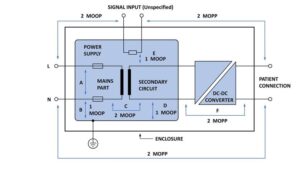
One of the most important concepts in medical power design is the distinction between Means of Operator Protection (MOOP) and Means of Patient Protection (MOPP).
Patients can be more vulnerable to electrical hazards than operators, particularly when medical equipment has conductive connections to the patient. As a result, medical equipment may require a higher level of protection between hazardous voltages and patient-accessible circuits.
Depending on the application, engineers may need to consider:
- 1 or 2 MOOP
- 1 or 2 MOPP
- Different insulation systems
- Specific creepage and clearance distances
- Defined dielectric withstand levels
This is why selecting a power supply based only on its output voltage and power rating is not sufficient. Its isolation and protection characteristics must also fit the device’s overall safety architecture.
Isolation, Creepage and Clearance
Isolation is fundamental to medical power-system design.
A medical power supply may need to provide reinforced or multiple levels of insulation between the AC input and accessible or patient-connected circuits. The required level depends on the application and the device’s protection architecture.
Two important physical considerations are creepage and clearance:
- Clearance is the shortest distance through air between two conductive parts.
- Creepage is the shortest distance along the surface of an insulating material between those parts.
The required distances depend on factors such as working voltage, insulation level, pollution degree, material characteristics, and MOP classification.
For engineers designing compact medical equipment, achieving the required distances can be challenging because PCB and mechanical space is often limited. This makes the power supply’s physical architecture an important consideration from the early design stages.
Leakage Current and Patient Safety
Leakage current is another critical consideration in medical equipment.
EMI filters, capacitors, insulation systems, and other components can create leakage paths. While leakage may be less restrictive in some industrial applications, medical equipment requires much tighter control, particularly when equipment is connected directly or indirectly to a patient.
Engineers may need to consider:
- Earth leakage current
- Touch current
- Patient leakage current
The applicable limits depend on the equipment configuration and classification.
This creates an important engineering trade-off between EMC performance and leakage current. EMI filtering can improve electromagnetic performance but may also increase leakage. The two requirements therefore need to be considered together when selecting and designing the power architecture.
IEC 60601-1 and EMC
Engineers should also distinguish between IEC 60601-1 and IEC 60601-1-2.
IEC 60601-1 primarily addresses basic safety and essential performance, while IEC 60601-1-2 addresses electromagnetic compatibility (EMC), including emissions and immunity.
Although they cover different aspects of medical equipment, they are closely connected from a power-system perspective.
Switching frequency, filtering, grounding, shielding, PCB layout, and cable configuration can all affect EMC performance. A power supply that performs well electrically may still create challenges when integrated into the complete medical device.
Considering EMC requirements early can therefore help avoid problems during later compliance testing.
Thermal Management and Reliability
Medical equipment may operate continuously for long periods, making thermal management and long-term reliability essential.
Power-supply efficiency directly affects heat generation:
Higher efficiency → lower power loss → lower thermal load
In compact medical equipment, limited airflow can make thermal management particularly challenging. Engineers should consider:
- Power density
- Operating temperature
- Cooling method
- Fanless operation
- Component lifetime
- Derating
- Continuous and peak loads
Thermal performance should be evaluated under realistic operating conditions rather than based solely on nominal specifications.
What Should Engineers Look for in a Medical Power Supply?
When evaluating a power supply for medical equipment, engineers should consider the complete set of application requirements.
Electrical performance
- Input voltage range
- Output voltage and power
- Continuous and peak loads
- Transient response
- Efficiency
Safety
- MOOP/MOPP
- Isolation
- Creepage and clearance
- Dielectric strength
- Leakage current
EMC
- Conducted emissions
- Radiated emissions
- Immunity
- Filtering
- System-level EMC performance
Mechanical and thermal requirements
- Form factor
- Power density
- Cooling
- Operating temperature
- Acoustic noise
Lifecycle support
- Component availability
- Long-term production support
- Documentation
- Configuration consistency
- Manufacturer engineering support
The best power supply is not necessarily the smallest or most efficient unit. It is the solution that meets the application’s electrical, safety, mechanical, thermal, regulatory, and lifecycle requirements as part of the complete system. Patient-connected designs, such as patient care equipment, carry the strictest isolation needs.
Why Power Supply Selection Should Happen Early
Power architecture decisions made late in development can create significant redesign risk.
Changing the power supply after PCB layouts, mechanical structures, isolation barriers, and certification testing have already been established can affect multiple parts of the product.
Early collaboration with a power-supply manufacturer allows engineers to evaluate:
- Isolation and MOPP/MOOP requirements
- Power and transient requirements
- Leakage current
- EMC considerations
- Thermal performance
- Form-factor constraints
- Customization requirements
For applications with unusual combinations of power, size, isolation, thermal, or EMC requirements, a semi-custom or fully customized power solution may be more appropriate than adapting the rest of the design around a standard product.
Conclusion
For medical-device engineers, power supply design is a system-level safety and reliability challenge.
IEC 60601-1 can significantly influence the power architecture through requirements related to MOPP and MOOP, isolation, creepage and clearance, leakage current, and protection against electric shock. At the same time, engineers must consider EMC, thermal performance, efficiency, reliability, form factor, and long-term product availability.
Addressing these requirements early can help reduce redesign risk and support a more reliable path toward medical-device compliance.
Horizon Electronics provides standard, semi-custom, and custom power solutions for medical equipment manufacturers, supporting applications from initial power requirements through development, manufacturing, and delivery.
Developing a medical device that requires a reliable and compliant power architecture? Contact Horizon Electronics to discuss your application and power requirements.